Loading page…
Why we intervene
Millions of children in Kenya's arid and semi-arid lands (ASALs) are kept from reaching their full potential by structural and socio-cultural barriers to education: a lack of teachers, too few teaching and learning materials, marginalisation and neglect by authorities, and disruption by violent extremism, terrorism and tribal clashes.
The scale of the problem
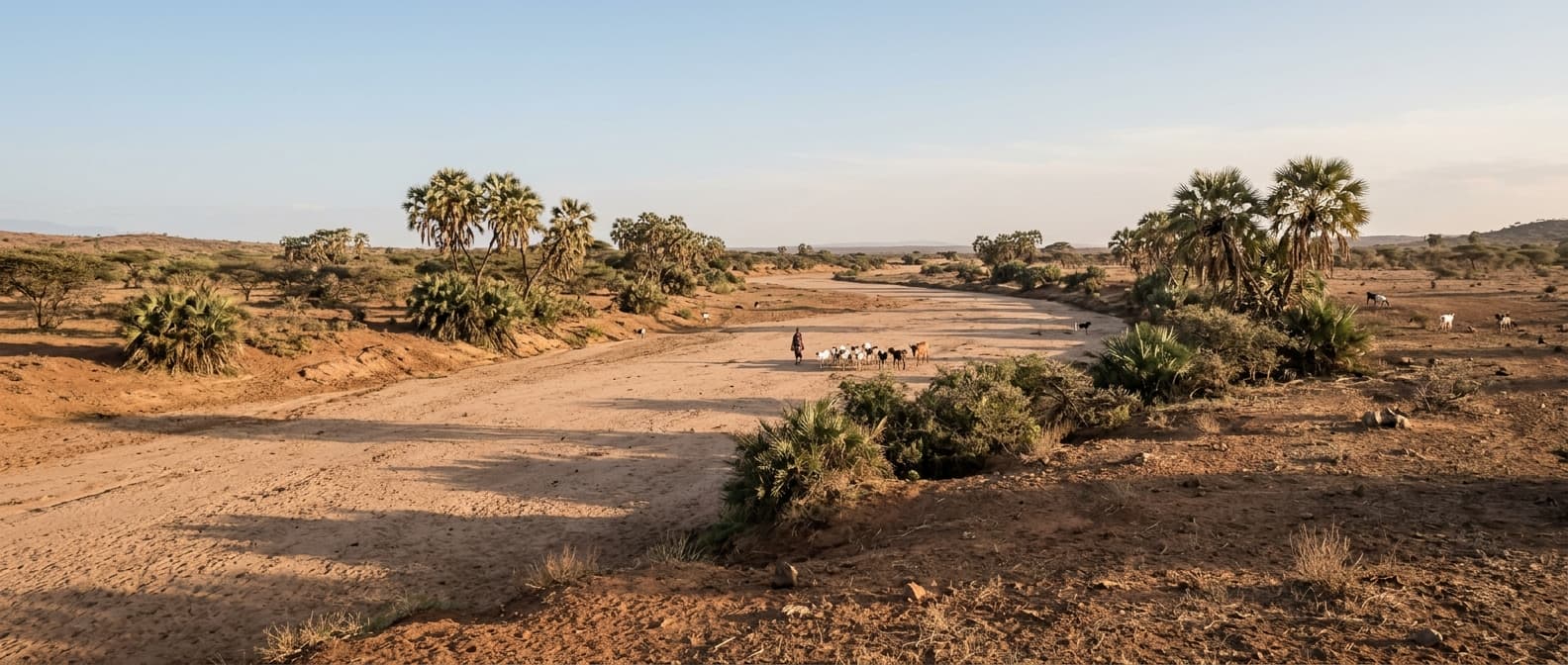
Northern Kenya covers more than 300,000 km² and is home to tens of thousands of basic-education learners. The region is marked by harsh environmental conditions, tribal clashes, religious extremism, terrorism, government neglect and the underdevelopment that follows.
Figures published by REACH-Education on the state of education in Kenya's arid and semi-arid lands.
Six barriers
A whole range of factors combine to prevent marginalised children from accessing education.
Pastoralist families move constantly in search of water and pasture for their livestock.
Communities live in largely inaccessible terrain, physically isolated and with little contact with wider society.
Children play a vital role in pastoral life, so parents and guardians are often reluctant to release them for formal schooling.
Long distances to school, poor infrastructure and the condition of existing nomadic schools keep marginalised children out of education.
The formal curriculum, timetable and school calendar are designed for settled communities and ignore the particular needs of nomadic peoples.
Teachers are scarce, and many have fled because of terrorist threats, leaving low levels of the skills and competencies schools need.
Justification
The state of education in Kenya's arid and semi-arid lands is dire: 90% of the country's 2 million unschooled children live in these regions.
Primary enrolment falls as low as 40% in many counties, against a national average of 95%.
Limited access to education, poor teaching quality, teacher shortages and too few classroom resources drive the crisis.
Violence, including terrorist attacks on schools, has affected schools, students and staff directly and indirectly, and teachers from other regions now avoid working there.
Teacher–pupil ratios fall below national standards, and completion rates and academic performance lag well behind national averages.
Many young people leave school disconnected from traditional livelihoods and without employable skills, which leaves them vulnerable to crime and extremist influence.
Mobile schools continue in some areas, but many have closed because of inadequate funding, supervision and community support rooted in the poor quality of education provided.
Persistent under-investment in basic education keeps these communities marginalised and out of reach of quality education.
Shortages of textbooks, instructional materials, classrooms and teachers, together with insecurity, severely limit children's access to learning.
In some schools the staff room has to serve several purposes at once, adding to the strain on resources.
Rolling out the Competency-Based Curriculum (CBC) brings further challenges for teachers, school communities, parents' associations and boards of management.
Questions and answers
Families move with their livestock, schools are far apart and poorly resourced, and the school calendar is designed for settled communities. Insecurity has driven many teachers away, leaving schools understaffed.
Kenya's arid and semi-arid lands. REACH-Education works in five of their counties: Garissa, Isiolo, Marsabit, Tana River and Wajir.
With learning that does not depend on a classroom or a constant connection (Self-Learning Kits, offline content and mobile apps) and with professional development, counselling and distance-teaching tools for teachers.
Our response